Water Flow Sensor Pulse To Flow Rate Calculation Method
Water Flow Sensor Pulse To Flow Rate Calculation Method
💡 Core Formula: Flow Rate (L/min) = Pulse Frequency Per Second (Hz) ÷ Coefficient
• USN-HS21TI: Coefficient = 10, so Q(L/min) = f / 10
• USN-HS06PA-1: Coefficient = 76, so Q(L/min) = f / 76
Product Overview
This article explains the calculation methods for instantaneous flow rate and total flow, as well as the formula derivation process. These contents are based on the working principle of water flow sensors such as USN-HS21TI or USN-HS06PA-1.
I. Basic Concepts
✅ Total Volume
● Refers to the total volume of liquid flowing through the sensor over a period of time.
● Unit: Liters (L), Milliliters (mL), etc.
● Calculation: Total pulse count × Volume per pulse.
✅ Instantaneous Flow Rate
● Refers to the volume of liquid flowing per unit time, i.e., the "current" flow speed.
● Unit: Liters/second (L/s), Liters/minute (L/min), etc.
● Calculation: Obtained by converting pulse frequency per unit time.
II. Key Parameters
| Parameter | Description |
|---|---|
| N | Total number of pulses detected within time t |
| t | Time (Unit: seconds s) |
| V_total | Total volume (Unit: liters L) |
| Q | Instantaneous flow rate (Unit: L/s) |
| f = N / t | Pulse frequency (Unit: Hz, pulses per second) |
III. Formula Derivation
Assumption: 600 pulses per liter of water
This means: Each pulse represents 1/600 liters of water
So:
V_total (L) = N × (1 / 600)
✅ Explanation: If N pulses are detected in total, the total water volume is N multiplied by the volume per pulse.
Total Volume = Flow Rate × Time
We know:
V_total (L) = Q (L/s) × t (s)
Combining the two expressions:
N / 600 = Q × t
Divide both sides by t:
N / (600 × t) = Q
→ Q = (N / t) / 600
Since N / t is the pulse frequency f (Unit: Hz), so:
Q (L/s) = f / 600
It can also be written as:
f = 600 × Q (L/s)
Unit Conversion for Instantaneous Flow Rate
✅ Unit: L/s (Liters/second)
Q(L/s) = f / 600
✅ Unit: L/min (Liters/minute)
● 1 minute = 60 seconds
● So flow per minute = flow per second × 60
Q(L/min) = (f / 600) × 60 = f × 60 / 600 = f / 10
✅ Unit: L/hour (Liters/hour)
● 1 hour = 3600 seconds
Q(L/hour) = (f / 600) × 3600 = f × 3600 / 600 = f × 6
f / 10 is L/min, multiplied by 60 gives L/hour → (f / 10) × 60 = f × 6
✅ So:
Q(L/hour) = f × 6
IV. Sensor Calibration Coefficients
USN-HS21TI (1/4" Household Pipe)
For USN-HS21TI sensor, the Hall sensor outputs 600 pulses per liter of water.
Product Features:
● Coefficient: 10
● Suitable for household 1/4" pipes
● Flow range: 1-30 L/min
● Volume per pulse: 1 / 600 liters
● Total volume formula: V_total (L) = N / 600
Instantaneous flow rate derivation:
Q(L/s) = f / 600
Q(L/min) = f / 10
Q(L/hour) = f × 6
USN-HS06PA-1 (Low Flow)
For USN-HS06PA-1 sensor, the Hall sensor outputs 4560 pulses per liter of water.
Product Features:
● Coefficient: 76
● Suitable for low flow applications
● Flow range: 0.15-1.5 L/min
● Volume per pulse: 1 / 4560 liters
● Total volume formula: V_total (L) = N / 4560
Instantaneous flow rate derivation:
Q(L/s) = f / 4560
Q(L/min) = f / 76
Q(L/hour) = f × 60 / 76 ≈ f × 0.789
V. Practical Calculation Examples
Example 1: USN-HS21TI (600 pulses/liter)
Assume at a certain moment:
● Pulse frequency f = 30 Hz (30 pulses per second)
Then:
● Q(L/s) = 30 / 600 = 0.05 L/s
● Q(L/min) = 30 / 10 = 3 L/min
● Q(L/hour) = 30 × 6 = 180 L/hour
✅ Conclusion: Current water flow rate is 3 liters per minute.
Example 2: USN-HS06PA-1 (4560 pulses/liter)
Assume f = 5 Hz
Then:
● Q(L/s) = 5 / 4560 ≈ 0.001096 L/s
● Q(L/min) = 5 / 76 ≈ 0.0658 L/min
● Q(L/hour) = 5 × 60 / 76 ≈ 3.95 L/hour
VI. Summary Table
| Sensor Model | Pulses per Liter | Coefficient | Flow Range | Total Volume Formula | Flow Rate Formula |
|---|---|---|---|---|---|
| USN-HS21TI | 600 | 10 | 1-30 L/min | V = N / 600 | Q(L/s) = f / 600 Q(L/min) = f / 10 Q(L/hour) = f × 6 |
| USN-HS06PA-1 | 4560 | 76 | 0.15-1.5 L/min | V = N / 4560 | Q(L/s) = f / 4560 Q(L/min) = f / 76 Q(L/hour) = f × 60 / 76 |
⚠️ Notes
1. The pulse coefficient is determined by the sensor model! Make sure to check your sensor specifications.
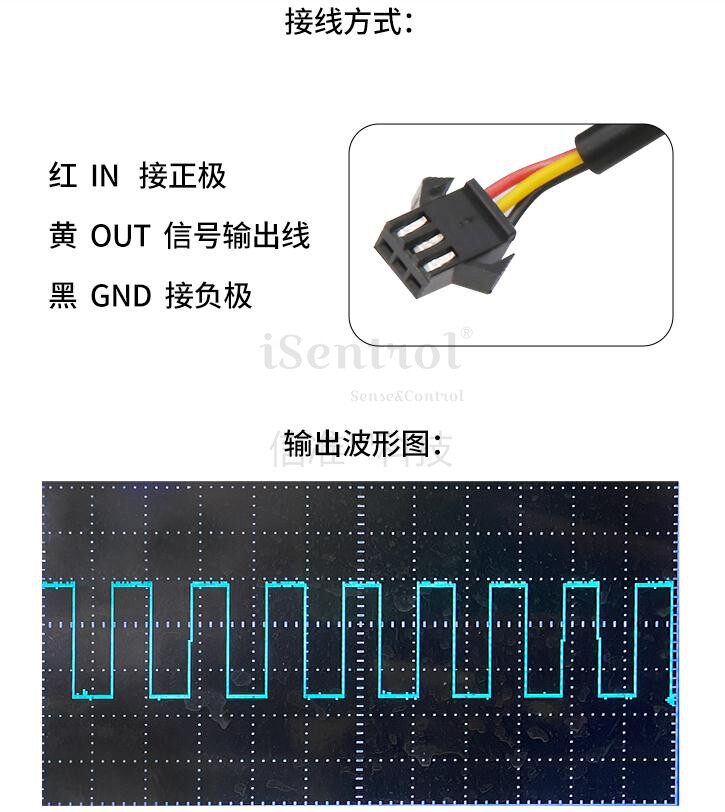
2. Use interrupt counting to accurately obtain N and f, to avoid missing pulses.
3. For high real-time requirements, it is recommended to update f every second to calculate the instantaneous flow rate.
4. Total flow can be obtained by accumulating all pulses and dividing by the coefficient.
💡 Practical Application Example
Sample code snippet (Arduino):
volatile unsigned long pulseCount = 0;
unsigned long lastMillis = 0;

void pulseHandler() {
  pulseCount++;
}

void loop() {
  unsigned long currentMillis = millis();
  if (currentMillis - lastMillis >= 1000) { // Update every second
    float f = pulseCount; // Frequency (Hz)
    float Q_L_per_min = f / 10; // Assume USN-HS21TI
    Serial.print("Flow rate: ");
    Serial.println(Q_L_per_min);

    // Update total volume
    totalVolume += f / 600; // Volume added per second

    pulseCount = 0; // Reset counter
    lastMillis = currentMillis;
  }
}
✅ Final Conclusion
Instantaneous Flow Rate = Pulse Frequency ÷ Pulses per Liter
Total Volume = Total Pulse Count ÷ Pulses per Liter
As long as you know the "pulses per liter" of your sensor, you can easily achieve accurate flow measurement!
Company Images
 | |
 |
SEO Information
| Keywords | water flow sensor,instantaneous flow rate,total flow,pulse frequency,USN-HS21TI,USN-HS06PA-1,flow calculation,iSentrol |
|---|---|
| Page Description | iSentrol Water Flow Sensor Calculation Method Guide - Detailed explanation of instantaneous flow rate and total flow calculation for USN-HS21TI and USN-HS06PA-1 sensors. |
| Tags | water flow sensor|instantaneous flow rate|total flow|pulse frequency|USN-HS21TI|USN-HS06PA-1|iSentrol |
| Static Page Name | water_flow_sensor_calculation_method |